

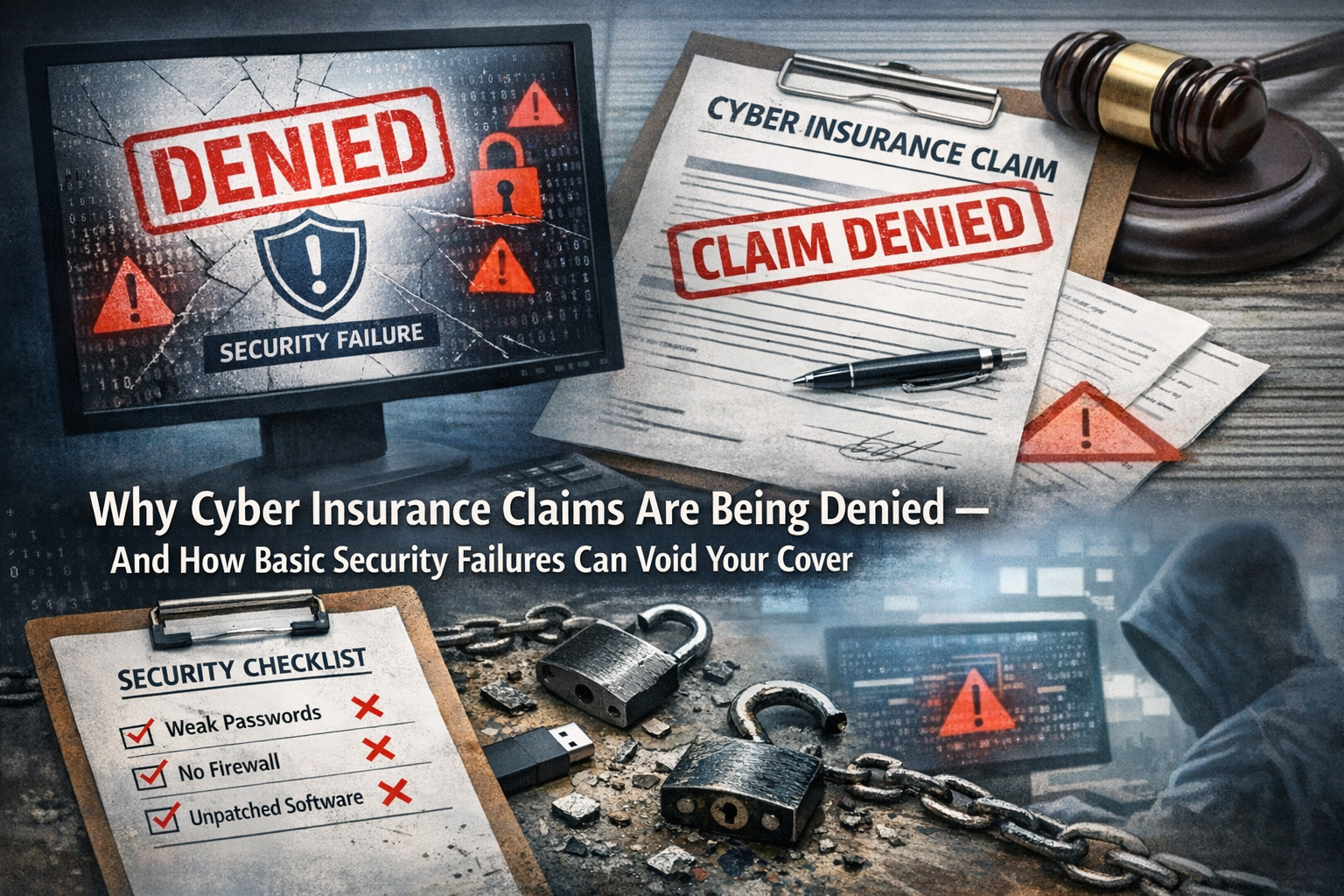
Why Cyber Insurance Claims Are Being Denied – And How Basic Security Failures Can Void Your Cover
Cyber insurance is often viewed as a safety net. Businesses pay their premiums, complete an application and assume that if the worst happens the policy will step in. Unfortunately, many organisations discover too late that having cyber insurance and being able to claim on it are very different things.
Over the last two years, insurers have dramatically tightened their underwriting and claims processes. As a result, a growing percentage of cyber insurance claims are either reduced or denied entirely. The most common reason is not fraud or excluded attack types, but the absence of basic, expected security controls.
Industry data now shows that between 25% and over 40% of cyber insurance claims are denied, with the majority linked to gaps or inconsistencies in core security practices such as multi‑factor authentication, patching and backup testing.
This article explains the three most common failures that invalidate cyber insurance claims and what businesses should be doing to protect both their systems and their insurance cover.
1. Incomplete or Partial MFA Deployment
Failure to fully deploy multi‑factor authentication is now the single biggest reason cyber insurance claims are denied.
Most modern cyber insurance policies now include MFA as a policy warranty or condition of cover, not a best‑practice recommendation. Insurers increasingly require MFA to be enforced across:
-
Email systems
-
VPN and remote access
-
Administrator and privileged accounts
-
Cloud platforms such as Microsoft 365
Many organisations believe they are compliant because MFA is enabled “in most places”. Unfortunately, insurers do not see it that way. A single unprotected account can be enough to void an entire claim if the attacker gained entry through that path.
A high‑profile example occurred in 2025 when the City of Hamilton in Canada had a multimillion‑dollar cyber insurance claim denied after a ransomware attack. Despite having workable backups, the insurer refused payment because several departments did not have MFA enabled, breaching policy requirements.
Insurers now expect MFA to be universal, enforced and provable at the time of the incident. Verbal assurances or partial deployment are no longer acceptable.
Authoritative sources
2. Delayed or Poor Patch Management
Another fast‑growing reason for denied claims is failure to patch known vulnerabilities within insurer‑defined timeframes.
Cyber insurers are increasingly using endorsements such as “neglected software exploit” clauses. These provisions allow insurers to reduce or reject claims if a breach results from exploiting a vulnerability that:
-
Was publicly known
-
Had an available patch
-
Was not remediated within a defined window, often 30 to 45 days
Some insurers are now using sliding‑scale reductions, where the longer a vulnerability remains unpatched, the lower the payout.
Importantly, this is not about patching everything instantly. Insurers are looking for evidence of:
-
Regular vulnerability scanning
-
Prioritisation of critical and exploited CVEs
-
A documented and repeatable patching process
Where organisations cannot provide proof that patching is actively managed, insurers may conclude that the breach was preventable, invalidating the claim.
Authoritative sources
3. Untested Backups and Unproven Restores
Backups are no longer enough on their own. Insurers now expect tested, documented and recoverable backups.
Common claim failures include:
-
Backups encrypted along with production systems
-
No evidence of restore tests
-
Backups that cannot meet recovery time expectations
-
Lack of offline or immutable backup copies
In ransomware incidents in particular, insurers almost always ask for restore test logs and recovery evidence. If this documentation does not exist, insurers may argue that losses were avoidable or inflated.
For UK businesses, this requirement is becoming explicit. Having backup software installed is not sufficient. Insurers want proof that restores were successfully tested before the incident occurred, not afterward.
Authoritative sources
How Many Claims Are Actually Denied?
While figures vary by insurer and sector, the consensus across multiple studies is clear:
-
At least 25% of cyber insurance claims are denied
-
In many datasets, the denial rate approaches 40–45%
-
The largest single category is missing or misrepresented basic security controls.
This makes cyber insurance increasingly similar to financial or health insurance. Coverage exists, but only if conditions are consistently met and documented.
Cyber Insurance Is Now a Security Test, Not a Safety Net
The key shift many businesses have not realised is this:
- Cyber insurance no longer protects weak security. It enforces strong security.
Insurers now conduct forensic‑level investigations after an incident, comparing policy applications against real‑world configurations. Any discrepancy around MFA, patching or backups can lead to denial, even if the gap seems minor.
How Bespoke IT Solutions Helps Businesses Stay Insurable
At Bespoke IT Solutions, we work with clients to align cybersecurity controls with insurer expectations, including:
-
End‑to‑end MFA enforcement across Microsoft 365 and remote access
-
Risk‑based patching and vulnerability reporting
-
Testable, auditable and recoverable backup strategies
-
Documentation designed to stand up to insurer scrutiny
Cyber insurance should be the final layer of protection, not the only one. By treating security controls as both technical safeguards and financial risk management, businesses greatly reduce the risk of denied claims when incidents occur.
Want help reviewing your cyber insurance readiness?
Speak to Bespoke IT Solutions to assess where your security posture may be putting your cover at risk.