


The Future of Global AI Investment
Where the money is coming from and why global conflict matters
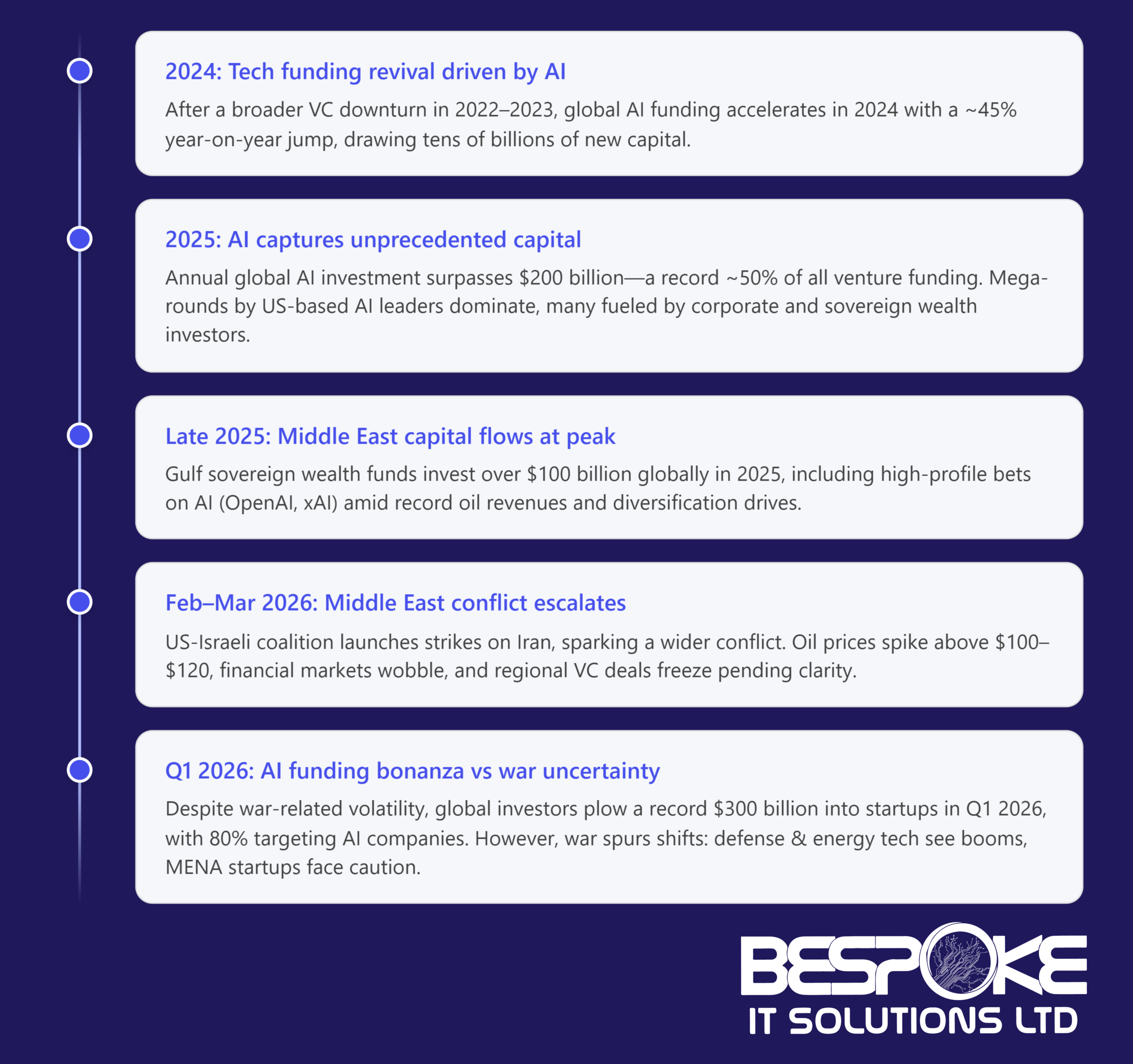
AI investment has grown at a staggering pace over the last two years. Funding levels have hit record highs, and the mix of investors has changed fast. Venture capital firms, global tech giants, governments, and oil-backed sovereign wealth funds are all placing big bets on AI.
But as we move through early 2026, a new challenge sits in the background. Geopolitical instability, particularly the conflict involving Iran, is beginning to influence where money flows and how confident investors feel.
This matters because AI investment does not exist in isolation. It is shaped by oil prices, inflation, interest rates, and political stability. All of these factors affect how quickly innovation moves from idea to real-world use.
This article looks at global AI investment trends across 2024 and 2025, then focuses on what has changed in the last three months. The aim is simple. To understand who is funding AI, how global conflict may affect those funding sources, and what that could mean next.
Global AI funding over the last two years
AI became the single biggest focus for global investment during 2024 and 2025. Investors rushed to support generative AI, automation, and advanced data systems.
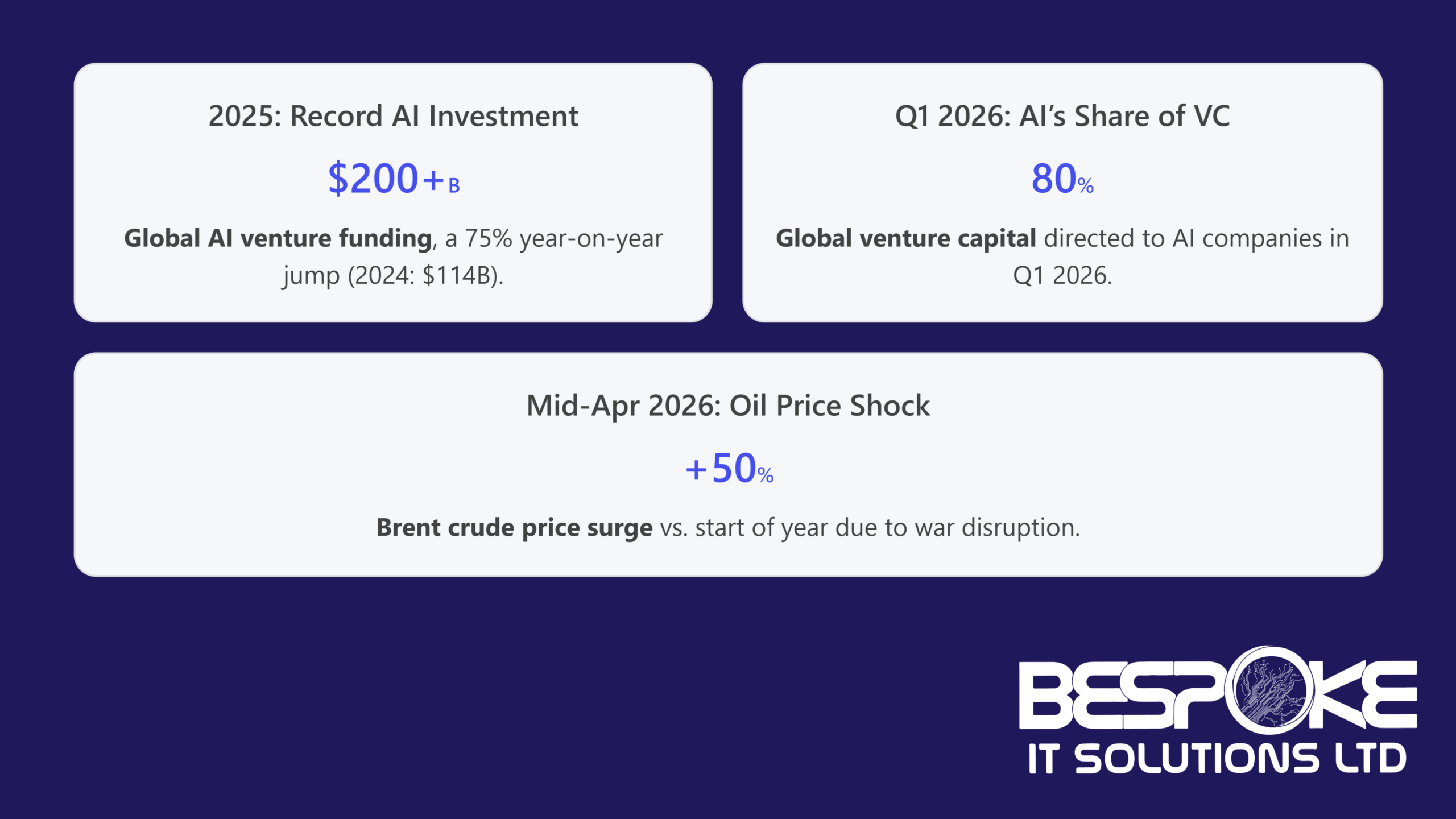
By the end of 2025, almost half of all venture capital worldwide was going into AI businesses. That figure was closer to one third just a year earlier. In 2025 alone, $202.3 billion was invested in AI startups. That is a 75 percent increase on the $114 billion invested in 2024. AI accounted for around half of all global startup funding.[wipo.int] [news.crunchbase.com], [news.crunchbase.com] [news.crunchbase.com]
Venture capital remained the main driver, leading roughly 75 percent of AI deals by number in 2025. However, the market became increasingly concentrated around very large late-stage investments. Corporate investors such as Meta, Google, Microsoft, and Nvidia played a major role, often leading multi‑billion‑dollar funding rounds to secure access to advanced AI capability.
Alternative investment groups also stepped in. SoftBank, backed by sovereign wealth funding, committed $40 billion to OpenAI in 2025 alone. This was the largest single AI investment on record and a clear signal of long‑term confidence.
[news.crunchbase.com], [news.crunchbase.com] [news.crunchbase.com]
[news.crunchbase.com], [news.crunchbase.com] [news.crunchbase.com]
Geographically, the United States dominated AI funding. In 2025, US companies attracted around $159 billion, representing nearly 80 percent of global AI investment. The San Francisco Bay Area alone raised over $120 billion. OpenAI reached a reported valuation of $500 billion, while Anthropic reached $183 billion.
Outside the US, funding levels were far lower. China and Europe trailed significantly. The Middle East, however, began to play a growing role. Gulf sovereign wealth funds, fuelled by oil revenues, increased their exposure to global technology and AI. Saudi Arabia’s Public Investment Fund took a $29 billion stake in Electronic Arts and supported funding rounds for AI firms including OpenAI and xAI. In total, Middle Eastern investors deployed an estimated $120 billion internationally in 2025, much of it into US technology. [news.crunchbase.com], [news.crunchbase.com] [news.crunchbase.com] [hai.stanford.edu], [hai.stanford.edu] [cfr.org], [cfr.org]
Funding Sources and Potential Indirect War Impacts
The following table summarises the major funding sources driving today’s AI boom, along with how the Middle East conflict might indirectly affect each:
| Source of AI Funding | Role & Recent Trends | Potential War-Related Impacts |
|---|---|---|
| Venture Capital & Private Equity | Leading AI funding source. Global VC & PE funds have funneled gigantic sums into AI startups (e.g., $300B in Q1 2026) [news.crunchbase.com], especially via mega-sized later-stage rounds and “AI-first” venture funds. | Higher inflation & interest rates from oil shocks and war-related uncertainty could raise capital costs and dampen risk appetite. VC activity may slow if conflict prolongs, as investors become more selective and valuations adjust downward [forbes.com], [forbes.com]. |
| Corporate Tech Investment | Massive internal & strategic spending. Big Tech firms (Amazon, Google, Microsoft, etc.) and others invest hundreds of billions on AI R&D, infrastructure, and acquisitions (e.g., Microsoft’s multibillion-dollar deals, Meta’s $14B in Scale AI funding) [news.crunchbase.com], [news.crunchbase.com]. | Mixed effects: Large incumbents have deep cash reserves; war-driven market volatility or inflation tends to have limited immediate impact on their R&D budgets. However, slower global growth or reduced gulf capital might push some to rely more on debt for AI expansion [cfr.org], [cfr.org], potentially affecting valuations or timing of big projects. |
| Sovereign Wealth & Energy Funds | Oil-fueled mega-investors. Gulf sovereign wealth funds (e.g., Saudi PIF, UAE’s ADIA/Mubadala) boast trillions in assets [cfr.org], [cfr.org] and became major backers of tech – committing over $100B globally in 2025, including AI ventures [cfr.org], [cfr.org]. They also invest via vehicles like SoftBank’s giant funds. | War strains local finances: Widespread conflict involving Iran has disrupted oil exports and tourism, forcing GCC states to tap surpluses for defence & domestic needs [cfr.org], [cfr.org]. Analysts warn this may temporarily reduce Gulf outflows to global tech [cfr.org], as some sovereign investors pause or prioritise local recovery over new overseas bets. Nonetheless, oil price spikes could offset some of this by boosting revenue and long-term capacity to invest once stability returns. |
| Government Programmes | Public spending & research. National governments fund AI via innovation grants, defence budgets, and industrial strategies (e.g. US DoD, China’s AI initiatives, EU digital programmes). These resources help seed early research and enable national AI capacity, though on a scale smaller than private flows. | Reallocation to security & stability: Amid conflict, defence and security AI projects often get priority. Western governments may boost funding for defence AI (e.g., autonomy, cybersecurity) as conflict underscores these needs [forbes.com], [forbes.com]. Conversely, war-related economic stress can constrain civil R&D budgets in heavily affected nations, shifting domestic focus away from tech innovation toward immediate necessities. |
| Public Markets & Capital Markets | Stock offerings & macro environment. Mature AI companies tap public markets via IPOs or stock issuances, and all funding relies on broader capital market health. Interest rates, global growth, and risk sentiment heavily influence valuations and fundraising conditions. | Market volatility & risk repricing: War has unsettled stock markets and raised safe-haven flows, increasing volatility [imf.org]. More critically, higher energy-driven inflation may delay interest rate cuts, prolonging a “higher for longer” rate environment that weighs on tech valuations [forbes.com]. If war effects persist, risk premiums can rise and IPO windows may stay narrow; companies could face higher financing costs or deferred listings until stability improves. |
Where AI funding comes from and how war can affect it
AI funding comes from several main sources. Each responds differently to global instability.
Venture capital and private equity remain the largest contributors. In early 2026 alone, these investors committed around $300 billion globally, with the majority going into AI.
[news.crunchbase.com]
[news.crunchbase.com]
However, conflict-driven inflation and higher interest rates increase the cost of borrowing. That can make investors more cautious and lead to slower deal activity or lower valuations if uncertainty continues.
[forbes.com]
[forbes.com]
Corporate technology investment is more resilient. Large firms have deep cash reserves and continue to invest heavily in AI research, platforms, and acquisitions. While market volatility can affect timing, most large tech firms are unlikely to cut back significantly in the short term.
[news.crunchbase.com], [cfr.org]
[news.crunchbase.com], [cfr.org]
Sovereign wealth and energy-backed funds are more exposed to regional conflict. Gulf funds manage trillions in assets and committed over $100 billion globally in 2025, including large AI investments.
[cfr.org]
[cfr.org]
The conflict involving Iran has disrupted oil exports, tourism, and trade routes. This forces governments to focus more on defence and domestic stability. Some sovereign funds may pause or reduce overseas investment in the short term, even though higher oil prices could rebuild capacity later.
[cfr.org]
[cfr.org]
Government funding often shifts during periods of conflict. Defence, cybersecurity, and surveillance technologies tend to receive more support, while civilian innovation budgets may come under pressure in affected regions.
[forbes.com]
[forbes.com]
Public markets are sensitive to uncertainty. War increases volatility, raises inflation risks, and can delay interest rate cuts. This affects valuations, IPO activity, and access to affordable capital.
[imf.org], [forbes.com]
[imf.org], [forbes.com]
What changed in early 2026
Between February and April 2026, AI investment remained extremely high. Global venture funding reached roughly $300 billion in Q1 alone, with around 80 percent going into AI. OpenAI raised approximately $122 billion in early 2026, pushing valuations to levels usually seen only in the largest public companies.
[news.crunchbase.com], [cfr.org]
[news.crunchbase.com], [cfr.org]
At the same time, the conflict has begun to influence where investors focus.
Defence and cybersecurity funding has accelerated. Autonomous systems, robotics, and security platforms have attracted strong interest. Investment in autonomous technology rose by 143 percent in 2025, reaching $12.1 billion, and this trend has continued into 2026. Defence-focused firms such as Anduril are reportedly raising multi‑billion‑dollar rounds.
[forbes.com]
[forbes.com]
Investment activity in the Middle East has slowed. Disruption to shipping routes such as the Strait of Hormuz has increased risk across the region. Many investors have adopted a wait‑and‑see approach, delaying deals until stability improves.
[forbes.com], [worldbank.org]
[forbes.com], [worldbank.org]
Oil prices have surged. Brent crude rose more than 50 percent by mid‑April 2026. While higher prices benefit producers long term, short‑term export disruption and war‑related spending have strained budgets. Saudi Arabia’s Public Investment Fund has indicated plans to reduce overseas investment exposure, shifting more focus to domestic priorities.
[worldbank.org], [cfr.org]
[worldbank.org], [cfr.org]
Inflation and interest rates remain a concern. Energy price shocks increase inflation pressure, making it harder for central banks to lower rates. Higher borrowing costs tend to cool risk‑heavy investment, even in fast‑growing sectors like AI.
[weforum.org], [forbes.com]
[weforum.org], [forbes.com]
What this means going forward
AI investment remains strong, but it is becoming more complex. The underlying drivers of AI growth are still there. Businesses continue to adopt automation, data intelligence, and generative tools at pace. Investors still believe AI will define the next decade.
What has changed is the environment around it.
Geopolitical instability does not stop innovation, but it reshapes it. Funding may shift toward defence, energy security, and resilience. Sovereign investors may become more selective. Valuations may stabilise rather than climb at record speed.
For organisations watching this space, the key takeaway is balance. AI funding will continue, but the mix of investors and priorities will evolve as global conditions change. Understanding these pressures helps businesses plan, invest wisely, and avoid relying too heavily on any single source of capital.
The AI revolution is still moving forward. It just needs steady footing as the world navigates a more uncertain landscape.
[weforum.org], [msci.com]
[weforum.org], [msci.com]