

AI, technology and UK business
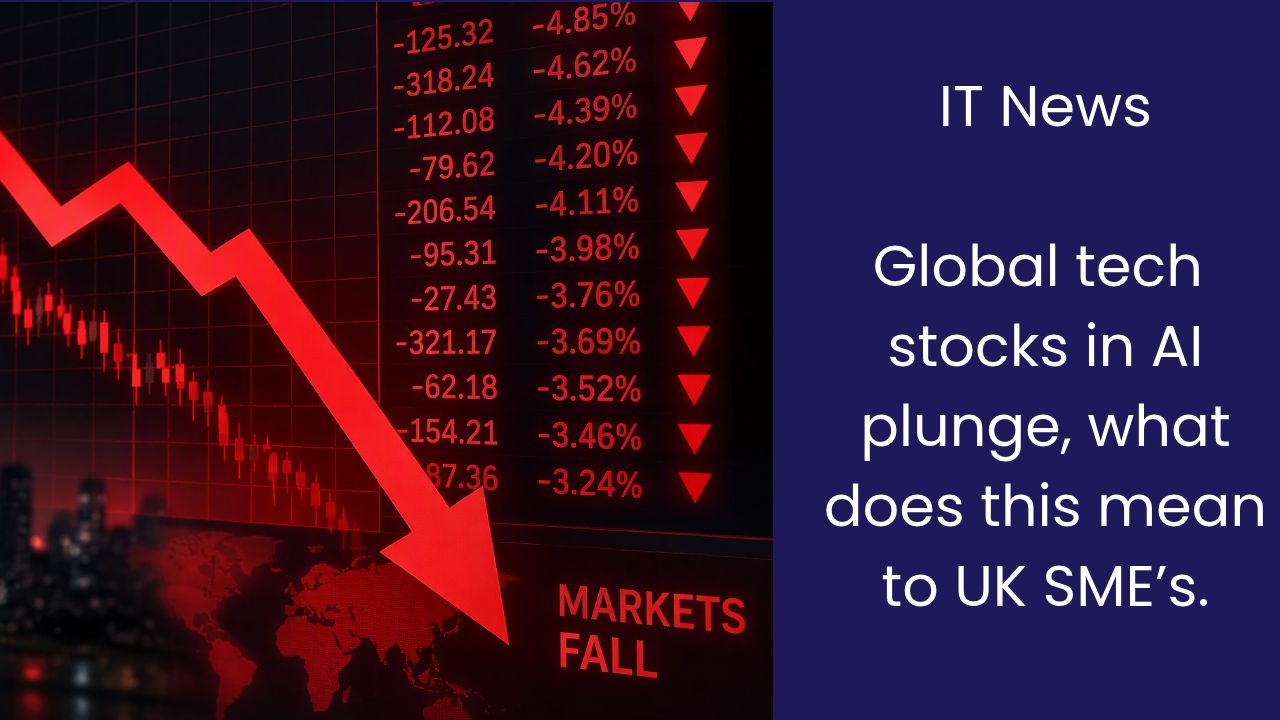
Global tech stocks plunge as AI slowdown fears spread
Technology shares have fallen sharply across America, Asia and Europe as investors question whether the enormous AI boom can continue at its current pace. For UK SMEs, this is not a reason to abandon AI. It is a reason to become much smarter about how we invest in it.
The short answer
The global sell-off does not mean AI has failed.
It means investors are demanding clearer evidence that the extraordinary sums being spent on AI infrastructure can produce sustainable financial returns. UK businesses should apply the same discipline to their own AI investments.
Artificial intelligence has spent the past few years being presented as almost unstoppable.
Investment has poured into AI chips, data centres, cloud infrastructure and software. Technology companies have reached extraordinary valuations. Businesses around the world have rushed to understand where AI fits into their future.
This week, that confidence received a significant shock.
US technology stocks fell sharply before the sell-off spread into technology-heavy markets across Asia and Europe.
The important question for business owners is not simply:
Why have technology shares fallen?
The more useful question is:
Does this change the case for businesses investing in AI?
The answer is more complicated than the headlines might suggest.
What has happened to global technology stocks?
The scale and speed of the sell-off have been significant.
The technology-heavy Nasdaq fell by 5.5% in one session. Reuters reported that approximately $3 trillion was wiped from the value of S&P 500 companies as investors reassessed their exposure to artificial intelligence.
The nervousness quickly reached Asia.
Japan’s Nikkei fell by around 6%, while South Korea’s Kospi fell by more than 8% at one stage. The fall was severe enough to trigger a temporary circuit breaker that paused trading.
Technology companies in Taiwan, South Korea and Japan were particularly exposed because these markets contain many of the chipmakers, memory manufacturers and equipment suppliers supporting America’s AI infrastructure expansion.
The disruption then spread into Europe, putting pressure on technology and infrastructure businesses linked to the AI investment cycle.
5.5%
The reported fall in the technology-heavy Nasdaq during the initial US sell-off.
$3 trillion
The approximate amount reportedly wiped from the value of S&P 500 companies.
More than 8%
The fall in South Korea’s Kospi at one stage, triggering a temporary circuit breaker.
The AI economy is global
This is not simply a bad day on an American stock exchange. The AI supply chain stretches from US cloud providers and data centres to semiconductor manufacturers in Taiwan, memory producers in South Korea, equipment suppliers in Japan and technology businesses across Europe.
Why are markets worried about AI?
There is no single explanation for the sudden change in sentiment.
Instead, several concerns appear to have collided.
Concern one
The politics around AI is changing
The latest US midterm elections became an important catalyst for the market reaction.
Several candidates campaigned on concerns about the rapid construction of AI data centres. These concerns include electricity demand, water consumption, infrastructure requirements and the effect large developments can have on local communities.
Investors are concerned that new political and regulatory pressure could slow parts of America’s AI infrastructure expansion.
Concern two
Investors want to see a return
This may be the most important part of the story for UK businesses.
Investors are increasingly asking when the extraordinary investment in AI will translate into equally extraordinary revenue, profit and productivity gains.
“There is also clearly an element of panic in the selling, and positioning is making the adjustment much more violent.”
Charu Chanana, Chief Investment Strategist at Saxo, quoted by Reuters
Concern three
AI infrastructure is extraordinarily expensive
The AI people interact with on a laptop or mobile device can make the technology appear almost weightless.
In reality, it depends on data centres, advanced chips, memory, networking equipment, cloud platforms, cooling systems, electricity and considerable financing.
Behind every AI prompt sits:
- Large-scale data centres
- Advanced processors and memory
- Cloud-computing infrastructure
- High-speed networking equipment
- Cooling and power-management systems
- Significant electricity capacity
- Capital investment and, increasingly, borrowed money
How much money is tied to the AI boom?
The scale of investment helps explain why a change in confidence can move global markets so quickly.
The International Monetary Fund says private-sector investment in AI could exceed $2 trillion globally during 2026, based on external estimates.
The IMF also estimates that technology investments associated with AI added approximately 0.5 percentage points to US economic growth in 2025.
However, it has warned that the returns from increasingly expensive and debt-financed AI projects could disappoint.
Why debt matters
Financial Times reporting, drawing on Morgan Stanley data, indicated that approximately $466 billion of AI-linked debt had been raised during 2026 by October.
When growth is financed through borrowing, investors become especially sensitive to delays, changing regulations, rising costs and weaker-than-expected commercial returns.
Has the AI bubble burst?
It is far too early to reach that conclusion.
The latest decline is dramatic, but context matters. Even after the initial fall, the Nasdaq remained higher than it was a year earlier and above its position at the beginning of 2026.
There are also analysts who see the current slowdown as a temporary adjustment within a much longer technology cycle.
A crucial distinction
A fall in AI-related share prices does not mean that AI has stopped working.
Markets are questioning whether the companies building AI infrastructure can generate sufficient returns to justify their valuations and investment. That is different from asking whether AI can help an individual business save time, improve service or become more productive.
What does this mean for a UK SME?
A 50-person business in Hampshire, Surrey or Berkshire is not building a multibillion-pound data centre.
It would therefore be easy to assume that the global sell-off has little relevance.
That would be a mistake.
The current situation provides a useful lesson about how businesses should approach AI investment themselves.
Stop investing in AI simply because it is AI.
Invest where technology can solve a measurable business problem.
AI is moving from excitement to accountability
For the past few years, businesses have been encouraged to experiment.
- Try Microsoft Copilot
- Try ChatGPT
- Try an AI meeting assistant
- Try an AI-powered CRM tool
- Try an AI chatbot
Experimentation has been useful, but businesses are now entering the next stage.
What did it actually achieve?
A simple AI business case
Imagine an AI-powered workflow saves ten employees 30 minutes on each working day.
Based on 230 working days, that could produce:
1,150 working hours saved per year
The business can then compare the value of those hours against licensing, deployment, training, integration, support and cyber-security costs.
AI then becomes a business case rather than a technology experiment.
Ironically, that is exactly the conversation investors are now having about the global AI industry.
Do not make the same mistake as the market
One of the most useful lessons from the current sell-off concerns expectations.
Huge sums have been invested because technology companies expect enormous future demand.
UK SMEs should avoid making the miniature equivalent of that mistake.
Do not begin with
“We need AI.”
Begin with
“We have a business problem.”
Once the problem is understood, the business can decide whether AI is the best answer.
A more sensible order for technology investment
Business problem → Process → Data → Security → Automation → AI → Measurement
Notice that AI appears quite far along that list.
Sometimes AI will be the right answer.
Sometimes a straightforward Microsoft Power Automate workflow could solve the problem more cheaply, reliably and securely.
That is not less innovative. It is better technology strategy.
Your existing IT now matters even more
The more powerful AI becomes, the more important the technology underneath it becomes.
Before rolling out Microsoft 365 Copilot, AI agents or other business-wide AI tools, organisations should understand:
- Who has access to company information
- Where sensitive data is stored
- Whether Microsoft 365 permissions are correct
- How user identities are protected
- Whether multi-factor authentication is properly deployed
- Whether company devices are appropriately managed
- How backup and recovery arrangements work
- Which unofficial AI tools employees are already using
- What information staff may provide to AI systems
- Where automation could solve a problem without generative AI
AI can amplify good IT and bad IT
Imagine an employee already has access to files they should not be able to view.
Giving that employee an AI assistant capable of locating, analysing and summarising information quickly does not correct the permissions problem. It could make the problem much easier to expose.
This is why AI readiness increasingly starts with IT readiness.
What happens if AI investment really does slow?
A sustained slowdown in global investment could have several consequences for SME technology buyers.
AI products could consolidate
Not every AI startup will survive indefinitely.
If funding becomes tighter, weaker software providers could disappear, merge or be acquired. Businesses should understand how they would recover their information if a supplier stopped trading.
Infrastructure expansion could slow
Lower data-centre investment could affect demand for processors, memory, servers, networking equipment and energy infrastructure.
This helps explain why technology markets in Taiwan, South Korea and Japan reacted so strongly.
Vendors may need to prove commercial value
This could be a healthy development. Instead of measuring success by the number of people trying an AI tool, vendors and customers may become more interested in the measurable value it produces.
Should UK businesses pause their AI plans?
In most cases, no.
But businesses should pause before adopting AI without a clear purpose.
Artificial intelligence still has considerable potential to improve productivity, communication, data analysis and customer service.
Potential, however, does not guarantee a return.
Rather than stopping AI programmes, sensible SMEs should make them more disciplined.
Seven questions to ask before your next AI investment
1. What exact business problem are we solving?
If the problem cannot be explained clearly in one sentence, do not start choosing the technology yet.
2. How will we measure success?
Choose a meaningful measure such as time saved, errors reduced, revenue generated, response speed or customer satisfaction.
3. Could standard automation solve it?
Review options such as Microsoft Power Automate before automatically reaching for generative AI.
4. Is our data ready?
AI will not magically repair years of duplicated files, inconsistent information or poorly configured permissions.
5. Is our technology environment secure?
Review Microsoft 365 access, multi-factor authentication, identity security, endpoint protection, backup and the AI tools employees already use.
6. Are we comfortable with the supplier?
Consider financial stability, contractual terms, security controls, data location, integration and what happens if the price changes.
7. Can we start with a controlled pilot?
Test the technology with a defined group, measure the result and only increase the investment if it works.
The biggest mistake would be walking away from AI
Dramatic market headlines can produce an equally dramatic response:
AI was overhyped, so AI must have failed.
That conclusion would be far too simplistic.
Stock prices reflect expectations about future profits. They are not a direct measurement of whether AI can improve an accounts process, reduce administration or help employees find information more quickly.
The current market turmoil does not remove the opportunity.
It increases the importance of discipline.
What should UK SMEs take away from the global AI sell-off?
The sharp fall in technology stocks demonstrates how much of the world’s investment, infrastructure and economic expectations are now tied to artificial intelligence.
It also demonstrates that enthusiasm eventually has to meet economics.
The same is true inside an individual business.
AI can be extraordinarily useful. But it should not receive a blank cheque simply because everybody is talking about it.
- Start with the problem
- Understand your existing IT
- Get your data and cyber security in order
- Use automation where automation is enough
- Apply AI where it genuinely adds value
- Measure the result and expand what works
AI should not be your business strategy.
A better business should be your strategy. AI is one of the tools that can help you get there.
Is your business ready for AI?
Before investing in another AI platform, it is worth understanding whether your IT, Microsoft 365 environment, cyber security, data and business processes are ready to support it.
Bespoke IT Solutions can help you identify where AI could deliver genuine value, where automation may be the better answer and what needs fixing before you start.
Sources and further reading
-
Reuters: Asia stocks crumble after AI rout rocks US markets
-
Reuters: European shares set to fall as global AI rout gathers pace
-
Bloomberg: Stocks plunge as traders reduce AI exposure
-
International Monetary Fund: AI deployment and disruption
-
Financial Times reporting: AI borrowing slows as investors reassess risk
Editorial note: Market figures in this article reflect reporting available at the time of writing. Financial markets can change quickly, and this article is intended as business and technology commentary rather than investment advice.